
Building an emergency fund on a low income can be challenging, but I’ll explain it in a simple way. When your income is low, saving money can feel almost impossible. The money comes in, the rent or mortgage is due, groceries have to be bought, the electricity bill arrives, and somehow the bank balance is already close to zero. Then one unexpected expense appears. Your car needs a repair. Your child needs medicine. Your working hours are reduced. Suddenly, even a $300 bill can turn into a serious financial problem.
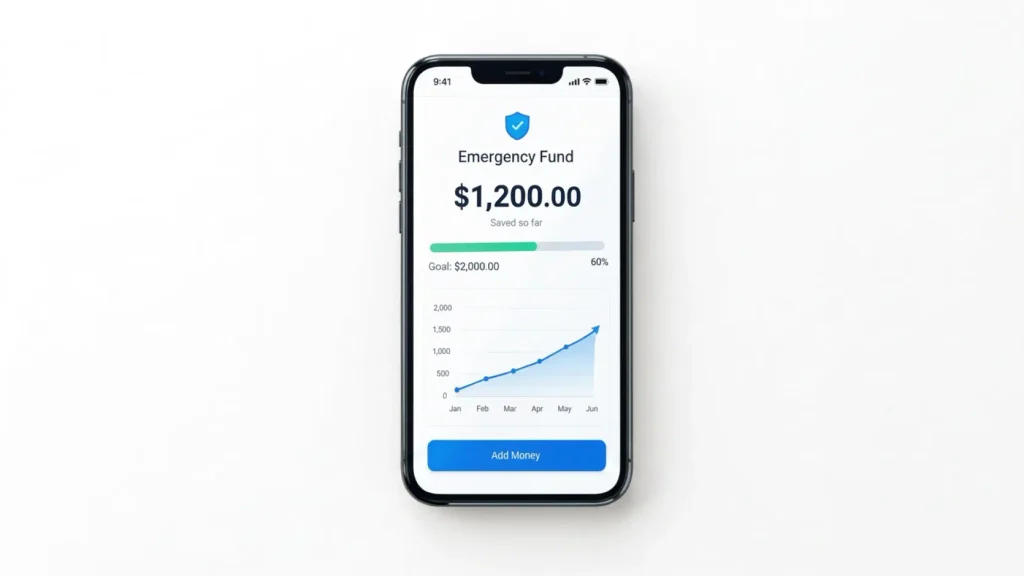
However, building an emergency fund on a low income does not mean putting away hundreds of dollars every month. In real life, the first goal is much smaller. It is about creating enough cash to handle an unexpected expense without immediately reaching for a credit card, payday loan, or borrowed money.
For someone living on a low income, even $100, $250, or $500 saved separately can create breathing room. Over time, that small amount can become a much stronger financial cushion.
The important part is not how quickly you build it. Instead, it is creating a system that works with the money you actually have.
What Is an Emergency Fund?
An emergency fund is money kept specifically for unexpected and necessary expenses.
For example, your emergency fund might cover an urgent car repair, an unexpected medical bill, essential home repairs, or a temporary loss of income. However, it is not normally meant for restaurant meals, shopping, vacations, or regular monthly bills that you already know are coming.
That difference matters.
When money is tight, it is easy to think that every extra dollar should immediately go toward debt or everyday spending. However, having no savings can leave you vulnerable to the next surprise expense.
Imagine that you have $50 left at the end of the month. You could spend it on something enjoyable, or you could keep it in a separate savings account. The second choice may not feel exciting today. Nevertheless, that $50 could become useful when something goes wrong next week.
The Consumer Financial Protection Bureau also explains why having emergency savings can help households manage financial shocks.
Why Building an Emergency Fund Is Hard on a Low Income
People often say, “Just save three to six months of expenses.”
That advice sounds simple. However, it can feel unrealistic for a household already struggling to cover basic costs.
If your monthly income is $2,000 and almost all of it goes toward housing, food, transportation, utilities, insurance, and other necessities, saving $600 every month may simply not be possible.
That does not mean you are bad with money.
Sometimes the problem is not unnecessary spending. Sometimes the gap between income and essential living costs is simply too small.
For that reason, an emergency fund for a low income household should be built gradually.
Instead of starting with a large target, start with a number that feels achievable. Once you reach it, continue from there.
Start With Your First $100
Your first emergency-fund milestone can be just $100.
It may sound small. Nevertheless, $100 can make a meaningful difference when your budget is tight.
Suppose your washing machine suddenly stops working and a repair costs $90. Without savings, you may need to use a credit card or borrow from someone. With $100 already saved, you have an option.
That is the real purpose of the first emergency fund.
You are buying financial flexibility.
After reaching $100, the next milestone could be $250. Then you might aim for $500. Later, you can work toward $1,000 or more.
There is no requirement that everyone reach the same number at the same speed.
Your income, household size, expenses, job stability, health costs, debt, and housing situation all matter.
Create a Small Gap Between Income and Spending
Building savings becomes easier when there is at least a small gap between what comes into your household and what goes out.
Therefore, begin by looking at your real monthly numbers.
Write down your income first. Then list your essential expenses, such as:
- Housing
- Food
- Electricity and other utilities
- Transportation
- Insurance
- Medicine and healthcare
- Minimum debt payments
- Phone and internet
- Childcare or other necessary family expenses
After that, look at what remains.
For example, suppose a household brings home $2,400 each month and essential expenses total $2,250. That leaves $150.
You do not necessarily need to put the entire $150 into savings.
Instead, perhaps $50 goes into the emergency fund, while the remaining $100 stays available for other needs.
At that pace, the emergency fund grows by $600 over a year.
That may not sound dramatic. Still, $600 is very different from having nothing.
Save Automatically When Possible
Saving manually requires you to remember to do it.
Unfortunately, money that remains in a checking account often gets spent. Therefore, automation can make saving easier.
If your employer pays you every two weeks, you could move a small fixed amount into savings after each paycheck.
For example, saving $10 from each weekly paycheck gives you roughly $520 over a year. Saving $20 gives you about $1,040.
The amount matters less than consistency.
Furthermore, you can increase the amount later when your income improves.
A separate savings account can also make the money easier to leave alone. Ideally, the account should be accessible for a genuine emergency but not mixed with your everyday spending money.
Use Extra Money to Strengthen the Fund
Your normal paycheck is not the only money that can build an emergency fund.
Occasionally, you may receive overtime pay, a tax refund, a work bonus, a cash gift, or income from selling something you no longer need.
You do not have to save all of it.
Even putting 10% or 20% of unexpected money into your emergency fund can gradually make a difference.
For example, receiving an unexpected $500 and putting $100 into savings immediately increases your financial cushion without changing your regular monthly budget.
Similarly, a $50 refund or small bonus can become part of the fund instead of disappearing into everyday spending.
Over a year, these small amounts can add up.
Keep Your Emergency Fund Separate From Everyday Money
One common problem is having savings but accidentally spending it.
For that reason, keeping emergency savings separate can help.
You might have one account for regular spending and another account specifically for emergencies.
Then, when you look at your checking account, you know that the money available there is meant for normal expenses.
Meanwhile, your emergency savings remains untouched unless something genuinely important happens.
This separation also makes progress easier to see.
Watching a balance grow from $100 to $250 and then to $500 can provide a sense of progress, especially when your income is limited.
What Counts as a Real Emergency?
This question becomes important once you have money saved.
An emergency is usually an unexpected expense that is necessary and cannot reasonably wait.
A major car repair may qualify because the car is needed for work.
An urgent medical expense may qualify because healthcare cannot always be delayed.
A broken essential household appliance may also qualify.
However, buying a new television because the old one is not the latest model is not normally an emergency.
Similarly, a planned holiday, birthday shopping, or annual insurance payment should generally be included in your normal budget rather than your emergency fund.
The clearer this distinction becomes, the longer your savings can last.
What If You Are Struggling to Pay Utility Bills?
Sometimes the best way to strengthen an emergency fund is to reduce the pressure from essential bills.
For U.S. households with low income, the Low Income Home Energy Assistance Program, commonly called LIHEAP, may provide help with home energy costs. The program can support eligible households with energy bills and, depending on the state or territory, may also provide crisis assistance, weatherization, or certain energy-related repairs. Eligibility and application rules vary by location.
This is important because an emergency fund should not have to carry every financial problem alone.
For example, if an eligible household receives energy assistance, money that would otherwise have gone toward a high utility bill may remain available for groceries, debt payments, or savings.
Lowering Other Household Costs Can Help
The same idea applies to housing, internet, healthcare, and other essential expenses.
For example, some older adults with low income may search for HUD apartments for seniors based on income, low income apartments, or low income housing with no waiting list.
However, housing assistance programs often have waiting lists, income requirements, household rules, and local availability limits. HUD’s Section 202 program, for example, supports rental housing for low-income adults age 62 and older.
Therefore, it is important not to assume that an apartment advertised online as having “no waiting list” is guaranteed to be available or legitimate.
The same caution applies to searches for income based apartments no waiting list and low income apartments no waiting list. Availability changes constantly, and housing assistance is often administered locally.
Affordable Internet Can Also Protect Your Budget
Internet access has become an important household expense.
For eligible U.S. households, the Lifeline program can provide a monthly discount on phone or internet service. Eligibility can be based on participation in certain government programs or household income. For 2026, the standard Lifeline benefit can provide up to $9.25 per month for internet or bundled service.
This can be particularly relevant for people searching for low cost internet for seniors on Social Security.
However, Social Security itself does not automatically mean everyone qualifies. Eligibility depends on the program’s rules, such as qualifying program participation or household income.
When an essential monthly bill becomes cheaper, the difference can potentially remain in the household budget. Over time, even a modest monthly saving can contribute to an emergency fund.
Healthcare Costs Can Destroy Savings Quickly
For many households, medical costs are one of the biggest threats to savings.
Therefore, low income households should pay attention to programs that may reduce eligible healthcare or prescription costs.
For people with Medicare, the Extra Help program can assist eligible individuals with Medicare Part D prescription drug costs, including premiums, deductibles, and coinsurance. In 2026, Medicare lists income and resource limits for Extra Help, although eligibility can change and certain people qualify automatically through other programs.
There are also Medicare Savings Programs that can help some people with limited income and resources pay certain Medicare costs.
This matters to emergency savings because lowering a recurring prescription or healthcare expense can create more room in the monthly budget.
In other words, financial stability is not always created by earning more money. Sometimes it also comes from making sure you are receiving programs for which you already qualify.
Your First Goal Does Not Have to Be Three Months of Expenses
A three-to-six-month emergency fund can be a useful long-term goal.
However, it should not become a reason to give up before you start.
If you have low income and currently have $0 saved, your first goal could be $100.
Then it could become $250.
After that, perhaps $500.
Eventually, you might reach one month of essential expenses. Later, if your financial situation improves, you can work toward a larger reserve.
The important point is that the fund should grow alongside your financial situation.
If you earn more next year, you can save more.
If your income falls, you may need to slow down temporarily.
That is normal.
What Happens When You Need to Use the Money?
Using your emergency fund does not mean you failed.
That is what the money is there for.
Suppose you spend $400 from a $1,000 emergency fund because your car needs an essential repair. Your balance falls to $600.
The next stage is simply rebuilding it.
This is one reason I prefer thinking of an emergency fund as a financial shock absorber rather than a savings competition.
You do not build it once and forget about it forever.
Life changes.
Your emergency fund changes with it.
Build the Habit Before Chasing a Big Number
The biggest change often happens when saving becomes normal.
At first, putting away $10 may feel almost pointless.
Then you do it again.
And again.
Eventually, saving becomes part of your normal financial routine.
That habit matters because your emergency fund is not only about the money sitting in the account. It is also about developing the ability to keep some money aside before everything else gets spent.
For a low income household, that habit can be more realistic and sustainable than trying to save a huge amount immediately.
Create a Small Gap Between Income and Spending
Saving money can be hard when your income is low. Most of your money may already go to rent, food, bills, and travel. Still, you can look for small expenses you do not need. For example, you may have an unused subscription. Canceling it can save a few dollars every month. You can read our guide on how to save money on subscriptions. Put the money you save into your emergency fund.
Use Extra Income to Strengthen Your Emergency Fund
Sometimes cutting expenses is not enough. You may need to earn some extra money. You can try overtime, freelance work, or a small side job. You do not need to save all the extra money. Even saving part of it can help. For example, you can put $20 from extra income into your emergency fund. If you like writing, read our guide on freelance writing as a side hustle.
Build Your Low Income Emergency Fund Slowly
You do not need to save a large amount at once. Start with a small goal. Your first goal could be $100. After that, try to reach $250. Then, you can work toward $500. Small savings can still help when an unexpected bill arrives. You can also read our guide on smart income management to learn how to manage your money better.
What Happens When You Need to Use the Money?
Sometimes you will need to use your emergency fund. That is normal. Your car may need a repair. You may have an unexpected medical bill. Something in your home may also break. These are reasons to use your savings. After using the money, start saving again when you can. If you are also using credit, our guide on how to build credit at 18 explains some basic ways to build credit responsibly.
The Real Goal Is Financial Breathing Room
An emergency fund is not about getting rich. It is about feeling safer when something unexpected happens. Even $100 can help with a small emergency. As your savings grow, you will have more protection. Later, you can also work on debt, long-term savings, and other financial goals. Read our guide on advanced financial security to learn more.
Final Thoughts
Building an emergency fund on a low income is not about finding a magical way to save hundreds of dollars every month.
Instead, it is about starting with what is realistic.
Your first $100 matters.
Your first $500 matters.
Your first month of essential expenses matters.
At the same time, reducing pressure from necessary expenses can make saving easier. Programs such as LIHEAP, HUD housing assistance, Lifeline, Medicare Savings Programs, and Medicare Extra Help may be relevant to eligible U.S. households with limited income, although each program has its own rules.
Most importantly, do not measure your progress against someone earning twice as much as you.
If you can save $10 this week, start there.
If you can save $25 next month, keep going.
Then, as your income rises or your expenses fall, increase the amount.
An emergency fund does not need to be impressive on day one. It simply needs to exist.
And when the next unexpected bill arrives, having even a small amount set aside can give you something that low income households often need most: financial breathing room when life does not go according to plan.