
Imagine sitting at your kitchen table with a pile of unpaid bills in front of you. Your electricity bill is due tomorrow. A medical bill needs checking. Your bank statement is somewhere under the paperwork. At the same time, you have an email reminding you about another payment. You keep telling yourself that you will handle everything after work. Then another busy day comes along, and the paperwork stays where it is. After reading this article, you’ll understand how much daily money manager fees can cost and what you should expect to pay.
This is how small money tasks can turn into a big problem. One missed payment can lead to a late fee. One misplaced document can create hours of extra work. Over time, even simple financial tasks can become stressful. That is where a daily money manager can help. This professional handles many of the routine financial tasks that people often struggle to keep up with.
However, there is one question that comes up before hiring one: How much do daily money manager fees cost in 2026? The answer is not as simple as one fixed number. Rates can change based on location, experience, workload, and the type of service required. In many cases, daily money managers charge by the hour. Some also offer monthly arrangements or project-based pricing.
So, before looking at one hourly rate and assuming that is your final cost, it helps to understand how the service is priced. Once you know what affects the bill, comparing different professionals becomes much easier.
What Is a Daily Money Manager?
A daily money manager, often called a DMM, helps people handle the practical side of their everyday finances. The work can include paying and organizing bills, keeping financial records, sorting paperwork, preparing documents, and helping with other routine money tasks. The exact service depends on the agreement between the client and the professional.
In everyday language, you can think of a DMM as someone who helps keep your financial paperwork under control. They do not simply sit down and make major financial decisions for you. Instead, they deal with many of the small tasks that need regular attention. That can be useful when someone has a busy schedule or simply has too much paperwork to manage.
For example, a person may have a mortgage, insurance payments, utility bills, medical bills, bank statements, and tax documents arriving throughout the month. None of these tasks may seem difficult on its own. Yet, when they all arrive at once, managing them can become frustrating.
According to the American Association of Daily Money Managers, DMM services can include bill payment, organizing financial records, making deposits, organizing tax documents, communicating with creditors, and coordinating information with other professionals.
That range of work explains why daily money manager fees can be different from one client to another. You are generally paying for the time and experience needed to keep these everyday financial tasks organized.
How Much Do Daily Money Manager Fees Cost in 2026?
There is no single national price for daily money management.
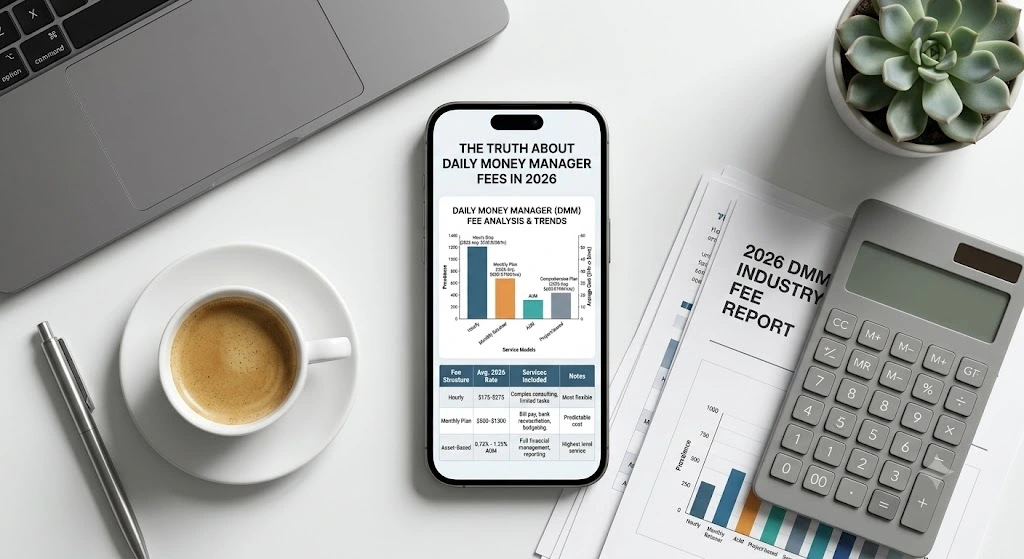
Instead, the market has a range of prices. Current 2026 industry discussions commonly place many hourly rates around $75 to $150 per hour. Some professionals and higher-cost markets can charge $200 or more per hour.
A simple way to understand the market is to look at these approximate ranges:
| Service level | Approximate hourly cost |
|---|---|
| Lower range | $50–$75 |
| Common range | $75–$150 |
| Higher range | $150–$200+ |
These figures should not be treated as official national rates. They are useful reference points when you start comparing services. AADMM explains that fees can vary based on geographic area and professional expertise.
Therefore, someone in a smaller city may receive a very different quote from someone in a major metropolitan area. Experience can also make a difference. A professional with many years of experience may charge more because the client is paying for that experience as well as the time spent on the work.
Why Does the Daily Money Manager Cost Vary?
At first, an hourly rate seems easy to understand. If someone charges $100 an hour and works for three hours, the basic calculation is $300. However, the actual cost can become more complicated when you look at the work involved.
Location is one important factor. Professionals working in areas with a higher cost of living may have higher rates. Experience can also affect pricing. Someone who has handled many different financial situations may charge more than someone who is new to the field.
The type of work matters just as much. Organizing a few monthly bills is very different from sorting through several years of financial records. A person with a simple financial life may need only a small amount of help. Another client may have multiple bank accounts, insurance policies, medical bills, tax documents, and other records that require much more time.
As a result, the daily money manager cost depends heavily on the amount and complexity of work involved. Two clients can hire professionals at the same hourly rate and still receive very different final bills.
Hourly Billing Is a Common Pricing Method
Hourly billing is a common way for daily money managers to charge clients. AADMM states that most daily money managers charge by the hour, although some professionals use monthly flat-rate arrangements.
The calculation is straightforward. Suppose a DMM charges $100 per hour. If the professional works for two hours during the month, the basic service charge would be $200. If the work takes five hours, the charge would become $500.
Now consider a client who needs regular help throughout the year. If the professional works five hours every month at $100 per hour, the basic yearly cost would be $6,000.
The hourly price has not changed in any of these examples. The amount of work has changed. That is why the number of hours often matters more than the advertised hourly rate.
Some clients need only occasional assistance. Others need regular support because their financial paperwork is extensive. Therefore, a person should look at the expected workload instead of judging the service only by its hourly price.
Monthly Daily Money Manager Fees Can Be Different
Not every professional uses an hourly-only system. Some daily money managers create monthly packages for clients who need regular service.
A monthly arrangement can make the cost easier to understand. Instead of receiving a different bill every month, the client may pay an agreed amount for a defined group of services.
However, there is no standard monthly price across the industry. One professional may include a certain number of hours. Another may base the package on the number of accounts, bills, visits, or tasks involved.
AADMM notes that some DMMs may establish a flat monthly rate, while others bill based on the work completed during the billing period.
Because of this, a monthly fee should never be judged by the number alone. The important question is what the monthly payment actually covers. A $400 monthly service may look expensive until you compare it with the amount of work included. On the other hand, a low monthly price may not be useful if many services are charged separately.
Travel Can Increase the Total Cost
The hourly rate is not always the only expense.
Some daily money managers visit clients at home. They may also travel to banks, offices, or other locations when the service requires it. AADMM states that many DMMs charge for travel time in addition to their regular rates. Other out-of-pocket expenses, such as postage, may also be billed to the client.
Consider two professionals who both charge $100 per hour. One works mainly from an office or remotely and does not travel often. The other regularly drives to clients and handles tasks outside the office.
Both professionals have the same hourly rate. Yet, the final cost may be different.
This is why it is important to understand the complete fee structure before starting the service. A low hourly rate does not always mean a low final bill if travel and other expenses are added.
What Can a Daily Money Manager Do?
The exact duties depend on the agreement, but daily money management usually focuses on routine financial administration.
A professional may help organize household bills, maintain financial records, prepare bank deposits, sort documents, organize tax paperwork, and communicate with creditors. Some may also coordinate information with accountants, attorneys, or other professionals.
AADMM lists services such as bill payment, bank-record organization, deposits, tax-document organization, and creditor communication among the work a DMM may perform.
However, it is important to understand the limits of the service. A daily money manager is not automatically an accountant, attorney, or investment professional. AADMM’s standards explain that DMMs do not act as accountants, financial advisors, or attorneys unless they have the appropriate education and licensing for those professions.
In simple terms, a DMM mainly helps with the practical side of everyday financial life. Major financial, legal, tax, or investment decisions may require a different professional.
A Simple Example of Daily Money Manager Cost
Let’s look at a realistic example.
Suppose Maria works full time and has a busy household. She has a mortgage, two credit cards, insurance payments, utility bills, subscriptions, and several financial statements arriving each month.
She does not need someone to make investment decisions. Her main problem is keeping up with paperwork and routine financial tasks.
Her daily money manager charges $100 per hour. The professional spends three hours each month handling the agreed work.
The basic monthly cost would be:
3 hours × $100 = $300
Over one year, the basic cost would be:
$300 × 12 months = $3,600
Now imagine another client who needs eight hours of help every month. At the same $100 hourly rate, the yearly cost would be:
8 hours × $100 × 12 months = $9,600
The hourly rate is identical in both cases. Yet, the yearly cost is very different.
That example shows why there is no single answer to the question, “How much does a daily money manager cost?” The workload plays a major role.
Daily Money Manager Fees for Older Adults
Older adults are one group that may use daily money management services.
As people get older, everyday financial administration can sometimes become harder to handle. Medical bills may increase. Insurance paperwork may become more complicated. Bank statements and other financial records can also become harder to organize.
At the same time, adult children may live far away. They may want to know that routine financial tasks are being handled without taking complete control of their parent’s finances.
A DMM can help with the administrative side of that situation. The client can remain involved in important decisions while the professional handles agreed routine tasks.
AADMM identifies older adults, people with disabilities, busy professionals, frequent travelers, and people with complex financial lives as groups that may benefit from daily money management services.
For families, the service can also create a more organized record of bills, documents, and other financial paperwork.
Experience and Certification Can Affect the Price
Experience is another factor that can influence daily money manager fees.
Some professionals have worked in bookkeeping, accounting, banking, office administration, or other financial fields before entering daily money management. Their background may influence their rates.
You may also see the Certified Daily Money Manager, or CDMM, designation.
AADMM’s certification program has specific requirements. These include professional experience, a background check, and an examination.
Certification is voluntary, so not every DMM will have this designation.
It is also important to understand that certification does not create one standard price. A certified professional in one city may charge less than another professional in a high-cost area.
Therefore, experience and certification can be useful when comparing professionals, but they are only part of the pricing picture.
The Difference Between an Hourly Rate and the Final Bill
This is one of the most important things to understand about daily money manager fees.
Suppose one professional charges $75 per hour. Another charges $125 per hour.
At first, the second professional looks much more expensive.
Now imagine the first professional needs six hours to complete the work. The total would be:
$75 × 6 = $450
The second professional completes the same work in three hours:
$125 × 3 = $375
In this example, the professional with the higher hourly rate produces the lower final bill.
This does not mean a higher hourly rate is always better. Instead, it shows why hourly price alone does not tell you the full cost.
The scope of work, experience, efficiency, travel, and additional expenses can all affect the final amount.
Can a Daily Money Manager Help Prevent Extra Costs?
Hiring a DMM is an expense, but the service can sometimes help prevent other financial problems.
For example, a missed bill may lead to a late charge. A forgotten subscription may continue taking money from a bank account. A medical bill may contain an error that goes unnoticed. Important paperwork may also become difficult to find when tax time arrives.
A DMM can help keep these routine tasks organized.
AADMM notes that DMMs can help busy professionals avoid late payments and can assist clients with everyday financial administration.
However, this does not mean every client will save more money than they spend on the service. The value depends on the person’s circumstances.
For someone who already manages every bill without difficulty, the cost may not make sense. For another person who constantly misses deadlines or struggles with paperwork, the service may provide much more value.
Financial Privacy Is an Important Part of the Relationship
Money management involves private information.
A DMM may see bank statements, bills, insurance documents, tax paperwork, and other personal financial records. Therefore, trust and privacy are extremely important.
AADMM’s professional standards address privacy, confidentiality, professional conduct, fee arrangements, and the protection of client interests.
A professional relationship should also have clear boundaries. The client should understand what information the DMM can access and what tasks the professional is allowed to perform.
This becomes even more important when a DMM works with an older adult or someone who has family members involved in financial matters.
Clear communication can prevent misunderstandings later.
What Should Be Included in the Fee Agreement?
A written agreement can make daily money manager fees much easier to understand.
AADMM recommends putting fee arrangements in writing before services begin. The agreement should explain the services, charges, payment methods, invoicing, and other important details.
The agreement should make it clear whether the client pays for regular work, travel time, postage, special projects, additional meetings, or other expenses.
This matters because misunderstandings often happen when a client assumes something is included while the professional considers it an extra service.
A clear agreement removes much of that confusion.
Is a Daily Money Manager Worth the Cost?
There is no universal answer.
For one person, paying $100 or more per hour may not seem worthwhile. That person may have a simple financial life and enough time to handle everything personally.
Another person may see the same service very differently.
A busy professional may value the time saved. An older adult may value having help with paperwork while remaining involved in financial decisions. An adult child may appreciate having a trusted professional help a parent with routine financial administration.
The value, therefore, is not only about the invoice.
It is also about the work being handled, the time being saved, and the stress that may be reduced.
At the same time, the service should still fit the client’s financial situation. Paying for help should not create a new financial problem.Managing Unexpected Expenses Alongside Daily Bills
Building an Emergency Fund Alongside Daily Money Management
A daily money manager can help you stay organized with bills, payments, and financial records. However, having some money set aside for unexpected expenses is also important. Even a small emergency fund can reduce financial stress when an unexpected bill arrives. If you are starting with limited income, read our guide on how to build an emergency fund on a low income to understand how you can begin saving step by step.
Managing Large Expenses With a Payment Plan
Unexpected medical and dental expenses can make monthly money management more difficult. In some cases, a payment plan can spread the cost over several months instead of requiring one large payment. Before agreeing to any plan, it is important to understand the total cost, monthly payment, and other charges. You can learn more in our guide on how to choose the right orthodontist payment plan in 2026.
Organizing Your Money for Greater Financial Freedom
Paying bills on time is only one part of managing your money well. A clear financial system can also help you save, control spending, and work toward bigger goals. Our guide to the 7 Pillars of Freedom for a Better Life in 2026 explores several areas that can help you build a stronger financial foundation.
Sources For Further Reading
The American Association of Daily Money Managers (AADMM) explains that daily money management can include practical tasks such as bill payment, organizing financial records, making deposits, preparing tax documents, and communicating with creditors. This gives readers a clearer idea of what a daily money manager actually does and how the service fits into everyday financial life. American Association of Daily Money Managers
Disclaimer: This article is for general educational purposes only. Daily money manager pricing can vary by professional, location, service scope, and individual circumstances. Always review the written fee agreement and understand all charges before hiring a service provider.